Showing posts with label Still Life. Show all posts

Sunday, May 17, 2015

Common glassware in Dutch Still Life painting during the Golden Age – Jugs.

This is a continuation of the series about glassware in Dutch paintings.  It is time for Jugs – These were made of ceramic either white, white and blue or brown looking more earthenware. They had a metal (pewter) cap attached to the handle and can be opened by pressing a thumb-lever just like a German stein today. The jugs were used for both beer or white wine. Vermeer used a white one for “The Music Lesson”, “The Sleeping Maid”, “this beautiful white-blue one for “The Procuress” and “Girl interrupted at her music” amongst others.

image image image

Johannes Vermeer – The Procuress - @ GemäldegalerieAlteMeister of Dresden, Germany

@ the Royal Ontario Museum, Toronto

My own

Feel free connect with me in Facebook or Twitter

Monday, February 9, 2015

Selecting and Arranging Objects to convey messages in modern Vanitas images. Prose statements in Vanitas.

Most people think that Vanitas images are “dark”, which; if you have been reading my blog you would know by now that this is not the case. Vanitas paintings were about the existing strict moral code in Calvinist Dutch Republic not about “Goth culture/subculture”.

Vanitas were very popular and many Dutch painters made a living from them. Antoine Steenwick, Peter Claesz, Harmen Steenwyck, David Bailly, Willem Calaesz Heda, Jan Davidsz De Heem and others.

After reading and researching a lot about the Dutch Golden Age, my own take is that Vanitas paintings were popular because the wealthy used them as pre-emptive “show off” pieces. That is, to tell the world about their awareness of the moral decay that can accompany wealth (specially unearned wealth). By hanging one of these pieces in their homes, the wealthy wanted to tell visitors “although I am rich, I follow our moral code (I have God teachings present in my life) and I am aware that wealth is temporary”.

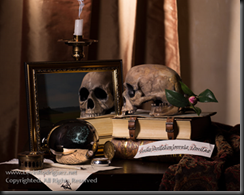
Once you understand this, it is a lot easier to compose images that follow that line of thought. Here are good examples.

image

image  image
Feel free connect with me in Facebook or Twitter

Tuesday, December 23, 2014

Common glassware in Dutch Still Life painting during the Golden Age, the Flute and Venetian glass

These were tall flute glasses normally shown with wine or beer. Pieter Claesz and Willem Claesz Heda used them quite often as shown in his still life “Breakfast with crab” at the Hermitage Museum in St Petersburg, Russia (one of the few World’s top museums I haven’t visited) and ”Ham and Silverware”. The one I used in my “Still Life a la Kalf” is made in Sweden according to the traditions of the times. The one shown at right can be seen at the Paul Getty Museum in Los Angeles.

597px-Heda,_Willem_Claesz_-_Breakfast_with_a_Lobster Blog2014__20120829_Getty_12_08_0090 Blog_Glass_069-4 Blog2014__20121216_VermeerKalf_sRGB

Willem Claesz Heda – Breakfast piece with a Lobster (1648)

@ Getty Museum

My own replica

See it here in a “Vermeer-Kalf” scene

Venetian glass – As its name indicate, these were made in Venice and easily identifiable by the ornate symmetrical “wings” at each side of the stem. The glass itself was quite thin and therefore fragile, no wonder they are really rare and as you can guess very expensive. The glass is shown tipped over in the first image from a Pieter Claesz painting.

A_Banquet_Piece_by_Pieter_Claesz,_Getty_Center Blog2014__20121230_ROM-7652 Blog2014__20140302_March 02, 2014-StillLife-15

Pieter Claesz -Banquet piece @ Getty Museum

@ the Royal Ontario Museum, Toronto

My own improvised glass

Monday, November 24, 2014

Common glassware in Dutch Still Life painting during the Golden Age, the Pass Glass A.k.a Pala glass

Another very common object in the Dutch Still Life paintings. These were usually octagonal glasses that were used for beer in drinking games. The glass had a blue glass swirl going around that was used to measure the beer in it. The glass was passed on from player to player (hence their name). The player in turn had to drink from measure to measure in one gulp, if he missed (no women were allowed) then he had to do it again. Here are some examples of pass glasses in Dutch Paintings. The last “photo-painting”  shows my own in one of my still lifes.

Since I could not find a real pass glass I had to “make” mine. I found a tall glass and I devised the swirl around it. The swirls is transparent but I could easily turn it blue, which I did for another glass…stay tune, it will be  included in this winter’s Still life run.

image image image

Rembrandt Van Rijn (1637) @ Gemäldegalerie Alte Meister of Dresden, Germany

Pieter Claesz – Still Life with Drinking Vessels

My own….

Rembrandt is holding one of these in his well-known Rembrandt and Saskia in the Scene of “the Prodigal Son in the Tavern” (first picture from left to right). Experts believe that the glass was cheap in the XVII Century which explains why you can see it in a Tavern.

Feel free connect with me in Facebook or Twitter

Monday, October 6, 2014

Common glassware in Dutch Still Life painting during the Golden Age, the Berkemeyer.

Berkemeyer – This German/Dutch glass was definitely popular in Holland at the time and it was included very often in still life paintings of the time. It looks very similar to a roemer, both being hollow with a thick stem; however the Berkemeyer top is a conical bowl whether the Roemer is oval. Berkemeyers are the most commonly found glass from the Seventeenth century, at the time was customary to hold it by the foot as shown in these details from Vermeer’s “The Glass of Wine” (at left) or Frans Hals “The Merry Drinker” at right.
clip_image002
clip_image004

Some examples of Berkemeyers
clip_image006
clip_image008
clip_image010
clip_image012
@ Getty Museum, Los Angeles
@ Royal Ontario Museum, Toronto
My own …replica from the Rijksmuseum, Amsterdam
In a “Vermeer” theme photo painting. Tip over as a symbol of fleeting life.

Friday, August 29, 2014

Common glassware in Dutch Still Life painting during the Golden Age, the Roemer.

Never before or even after has Still Life painting being as popular as during the XVII Century Dutch Republic also known as the Golden Age. Still life painting developed different styles, little breakfast (ontbijts); banquets (banketjes); ostentatious (pronks), flower bouquets, vanitas etc. Most of these styles used glassware, sometimes because their texture (as a way for the artist to showcase his skills), sometimes to provide a symbol (broken or tipped over glass) or sometimes just as a recipient as in flower bouquets.
These glasses appear over and over again in the paintings of Piter Claesz, Pieter Claeszoom Heda, Willem Kalf, Jan Davidsz de Heem, Abraham Van Beyeren, Clara Peeters, Johannes Vermeer, Pieter de Hooch, Frans Hals, Rembrard Van Rijn and other masters. However the still life masters made extensive use of them, they painted dinner tables after all.

clip_image002 clip_image004 clip_image006
Pieter Claesz – Getty Museum in Los Angeles, CA Pieter Claez - LACMA
Los Angeles, CA
My own, showing a small roemer
I thought it may be interesting to readers to see in one place all different glasses and their names and places where to see them.
clip_image008Roemer – The name Roemer (sometimes seen as rummer) comes from the German word “Roman”. This glass can be found in several sizes, sometimes real big sometimes smaller. It appears very often in all still life and genre paintings, normally with white wine or water. See these examples:
The base could be round or sometimes had small spikes similar to a Berkemeyer (see Berkemeyer). The glass stem is hollow and has prunts on the outside. These prunts could have different shapes, sometimes they looked like berries, sometimes like spikes. At the time, people ate with their hands which were greasy; the prunts helped prevent the glass from slipping and were common in other glasses like the berkemeyer or some other goblets.
See these examples from the Getty Museum in LA.
clip_image010 clip_image012 clip_image014 clip_image016

Next post will be about Berkemeyers and other type of glasses
Feel free connect with me in Facebook or Twitter


Thursday, May 1, 2014

Girl Reading a Letter at an open window


In his book Vermeer’s Hat Professor, Timothy Brooks takes us through the vibrant trade between the new Dutch Republic and the far east, specifically China. He goes through almost every painting identifying objects used by Vermeer and connecting them with the Dutch trade via the first publicly traded company in the world, the Dutch East India Company, Vereenigde Oostindische Blog2014__20120721_Vermeer_GirlClosedWindowAndKeptLetterCompagnie or VOC for short.
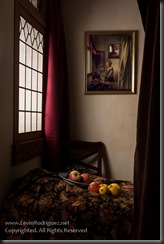
Blog2014__20130408_girl-reading-a-letter-by-an-open-window-by-johannes-vermeer Reading the book gave me some ideas about what could possibly doing the “Girl Reading a Letter at an open Window” a.k.a. “The Letter Reader”. Here is my story which is split into two images. Fist the girl in Vermeer’s painting is gone, second a woman is there reading the letter.
First: A girl has read a letter from her lover; a merchant traveling to the Far East on a trading ship. The window is her favourite place to read his letters; the bright light allows her to see all the details of her lover's writings. By now, she carefully folded the letter and tucked in with the all others in a secure drawer in the dresser next room. The Picture in the background reflects the time when she was anxiously reading the letter. 
The self-repeating theme in the frame is an allegory to the many times this scene has occurred in the past but also, to the infinite nature of Vermeer's work.

Second (right): Catharine Bolnes, Vermeer wife has found a letter from an admirer addressed of one of her
older daughters. She must have forgotten to put it away. Catharina is now reading the letter in stupor realizing that her daughter hasn't told her about this pretender. Why hasn't she told her, Is she preparing to elope, like she and Johannes did?

Inspired by Johannes Vermeer -Girl reading a letter at an open window- c. oil on canvas 32 3/4 x 25 3/8 (84 x 65.5 cm) Staaliche Kunstammlungen, Dresden. 
Feel free to connect with me in Facebook or Twitter


Tuesday, May 28, 2013

Vermeer and Willem Kalf’s Pronkstillevens

Although Vermeer quickly moved from humble (the Milkmaid) to more affluent subjects, he never took it to the level of Willem Kalf and followers. Kalf developed a style called “pronkstilleven” or “ostentatious still life” , these were highly detailed paintings portraying the riches of the very rich in the Dutch Republic. A typical pronkstilleven would be an arrangements of Nautilus cups, very decorated silver jars, (Wan-li a.k.a Kraak ) fine Chinese porcelain, buckelpokals, outrageously expensive oriental rugs, expensive weapons, works of art, etc. Kalf normally placed them on tables but some of his followers like Jan Davidsz de Heem, Van Beyeren and others used rooms. 

Kalf was also a successful Art dealer, based in Rotterdam, a City with access to the sea and the home of many rich and wealthy Dutch merchants. In contrast, Vermeer lived in Delft which was a more modest city. Vermeer lacked the rich patrons of Amsterdam and Rotterdam. His main patrons were Pieter Claeez Van Ruijven and his wife Maria de Knuijt who amassed most of Vermeer works, twenty-one of the thirty-five known today.
 
So, this is the background information. I thought about a story that would connect Vermeer and Kalf so that I could explore it visually. Here is what I got:
 
Vermeer started looking for new patrons or dealers that could help him break the lock that Pieter Claesz Van Ruijven and his wife Maria de Knuijt had on his works. Van Ruijven paid him well, however, Vermeer he thought that he could get higher prices from other sources. After all, Rembrandt Van Rijn was being paid handsome sums in Amsterdam for his historic paintings so why not him in Delft.
 
One of his colleagues in the Delft’s Guild of Saint Luke, suggested to him to meet Willem Kalf, a well-known painter, turned dealer and appraiser who lived in Rotterdam. (the photo painting at right was inspired by the works of Abraham Van Beijeren who was one of Kalf's followers)
 
Vermeer took his favorite showing piece “Allegory of Painting”; and went to see Kalf in Rotterdam. He was quite impressed by Kalf’s detailed works that included richly decorated silverwares, Chinese porcelain dishes, fancy Venetian glasses and exotic fruits. Vermeer however, did not like the darkness and fuzziness of Kalf’s backgrounds, he decided to try a different approach by incorporating some of Kalf designs but make them his own. He then included similar objects in but used his recognizable background (see at right) with the light coming from the left, one of his Spanish chairs and included one of Kalf’s own paintings (this particular one is closer to a Van Beijeren) in the background. This way he was sure to impress Kalf enough, to obtain representation.


Feel free to connect with me in Facebook or Twitter

Friday, March 22, 2013

Vermeer and Vanitas Paintings

Vermeer did painted allegories; we know at least two of them: Allegory of Faith and Allegory of Painting. However, although very fashionable in his time, there is a notable absence of “memento mori” symbols in Vermeer paintings.  He never used typical vanitas symbols like skulls, watches, decaying flowers or just snuffed candles. Many of his paintings included musical instruments (music was an indulgence of the senses) but they were normally related to the scene e.g “Girl interrupted in her music”, “The Music Lesson:” , “Woman with a lute”, etc. He must have known about these pieces, they were very popular in the United Provinces. Maybe, because he converted to Catholicism when married.

However, according to the Essential Vermeer site “A Lady writing”, in display at the National Art Gallery (NGA) in Washington has a painting with a bass viol in the background. They believe is the same found in the inventory compiled after Vermeer’s death, listed as “bass viol with a skull”. If true, this would make it the only clear Vanitas presence in any Vermeer painting.

I downloaded the high resolution image and inspected it as best as I could and I can’t see the skull. Maybe I have to go to Washington to confirm it.


In any case, following my theme of exploring possible still life themes with Vermeer characteristics, I thought that the vanitas theme had to be addressed. This is the premise behind the “A Vanitas for the Stadhouder”.

The premise of the image is that Vermeer has been commissioned by the Stadhouder or City Holder. Normally one of the most powerful persons in the province. As he is immensely rich, so he thought that it would be a good idea to make a statement about his adherence to Dutch traditions of modesty and spiritual elevation; an unwritten rule of acceptable behavior at the time.

According to my story, the Stadhouder commissioned Vermeer to paint a "Vanitas" for his office. These were fashionable pieces that communicated restrain and humility and adhesion to the established moral of  standards at the time. A Vanitas painting with his own portrait would serve as reminder to all visitors that he is fully aware of the transient nature of life and therefore the need to avoid vanities while maintaining a adherence to the Calvinist teachings.

He chose the pieces wisely, following the latest trends set by Pieter Claesz from Harlem and Steenwijck in Leiden. On the table, a rich oriental carpet has been pushed aside to make room for a mirror as symbol of vanity and therefore something to be avoided, a skull to remind us that death is unavoidable and that we should not be overwhelmed by earthly riches, an hourglass remind the viewer that time is passing quickly and therefore should be used wisely. The smoke from the extinguished candle symbolizes the ephemeral nature of our existence, wealth and knowledge.

Feel free to connect with me in Facebook or Twitter

Tuesday, February 5, 2013

Johannes Vermeer and Flower Painting during the Dutch Golden Age


Ambrosius Bosschaert the Elder created a dynasty of painters dedicated to flower bouquets. He was very sought after and his paintings demanded very high prices. He influenced many others and flowers were commonly shown in other paintings of this period. However, flowers are all but absent from Vermeer’s work. They are laborious and therefore time consuming. He would rather paint a detailed map of the United Provinces, so detailed that his maker could be identified, than one single rose, iris or tulip.


So, I took it on myself to address this. I wanted to create an photographic painting of what would a flower bouquet painting by Vermeer would look like. That is, a composition that could be recognized as a Vermeer painting by the lighting and other recognizable elements but with a typical Dutch Golden Age flower bouquet.
 
This is how I came about “The Bosschaert’s are visiting” which is about a fictional encounter between Vermeer and Bosschaert. This would have been the encounter of two titans. You can just imagine the discussing their styles, the market for paintings and other typical discussion of the time, while sipping white wine in their berkemeyers. 

Even as a fiction, I had to verify whether this could have been possible back in the XVII Century, Unfortunally it wasn’t, Bosschaert had passed away before Vermeer was a master. But,Balthasar Van der Ast who was Bosschaert bother in law, was a fine painter of flower bouquets in his own right. He would fit the bill nicely.

I am a visual person, so I decided that the easiest way to see how all these painters shared time I decided to plot their life spans into what is the following graphic. I included those painters that I have been working with, plus some others that are relevant to my work about the Dutch Golden Age, e.g. Peter de Hooch. Rembrandt was included as he was widely recognized at the time as the top painter in the United Provinces.

Feel free to connect with me in Facebook or Twitter


Thursday, January 3, 2013

More about Vermeer as a Still Life painter. “The Milkmaid” and “the Maid left”

In my previous article I explored the fact that although Johannes Vermeer is regarded as a "genre" painter, his works contained several still life compositions. Also some of them portrayed people almost frozen, notably “Woman with a balance” and “The Milkmaid” or ”Kitchen Maid”. The latter being one of Vermeer’s most recognizable paintings. 

In reality, most people in Vermeer paintings are showing no signs of movement, they are glazing at something, many looking at the painter or photographer. In this regard, his genre paintings were all real still life paintings. People were as inanimate as glassware was in Pieter Claesz ontbijts.  

Look at the painting, even with the maid present, this painting is closer to a still life than a genre painting. What’s she doing anyway? she is slowly pouring the milk into a container. The image suggest that she is doing this patiently and attentively, her eyes and attention are into the trivial task of pouring milk, nothing else matters. 


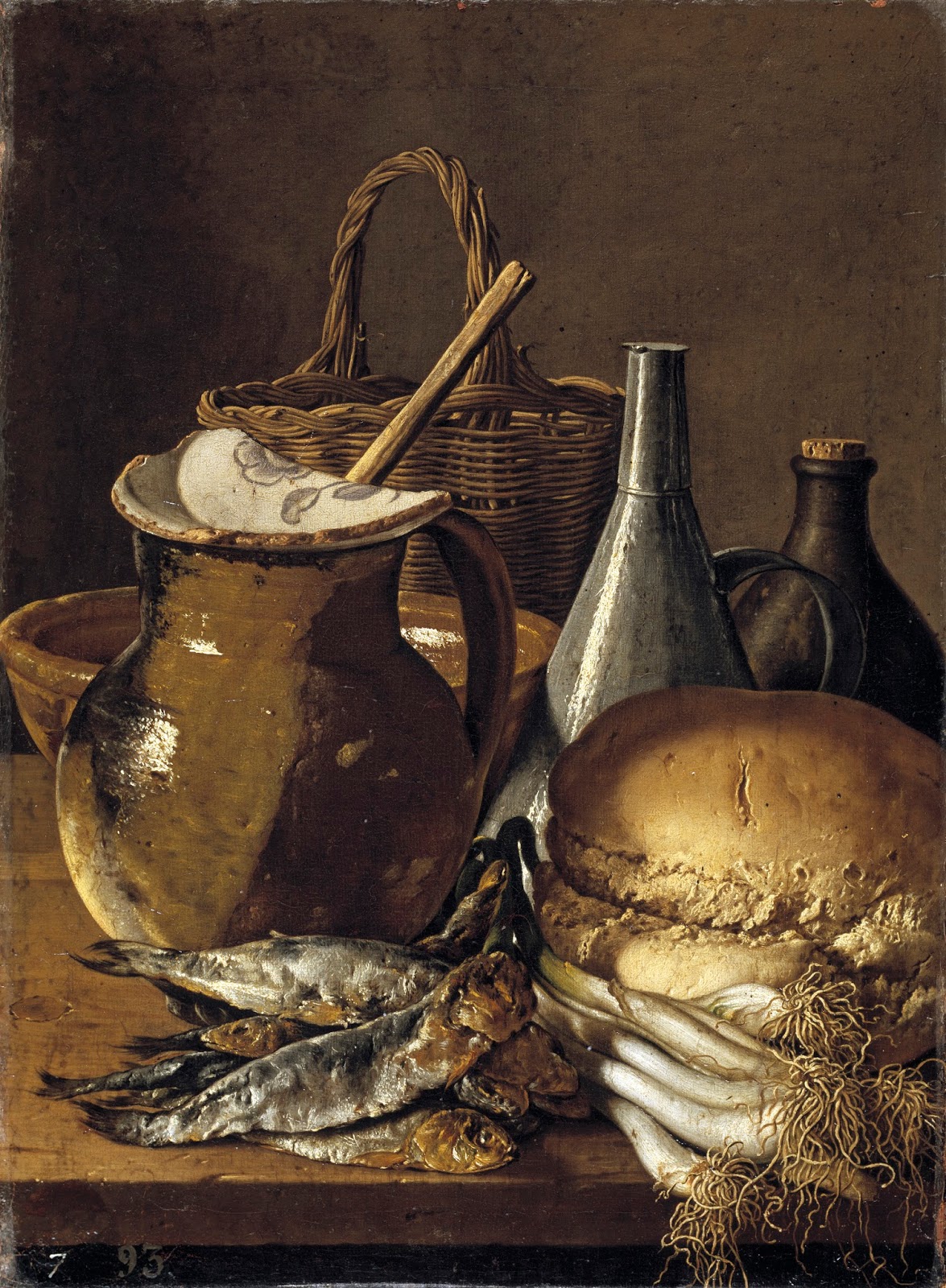
There is nothing that suggest movement, other than the milk. There is nothing else for our eyes to wander around. The table has several simple rustic objects that are all nicely arranged, closer to a Luis Melendez ‘bodegón’ (see image at the bottom, right), than a genre painting by Vermeer, De Hooch or any other contemporary painter. But, unlike Melendez, Vermeer used objects that were common in the Dutch
Republic in the 1600’s, like the blue tankard or the foot warmer at the corner of the “Milkmaid.

It was this kind of thinking that encourage me to think about what would the image look like if the maid had left to do her daily chores? Why would Vermeer make this room so stark and boring? I don’t think anybody knows the answer, so I decided to provide my own story which included the addition of a rose in a small roemer. By the way, Vermeer did not painted one single flower in any of his 35 known paintings.

You can read my version of the story here…

Sunday, December 16, 2012

Vermeer as a Still Life Painter

Johannes Vermeer works are classified as ‘genre’ paintings and not still life; however, numerous of his works contain arrangements of inanimate objects similar of those still life painters of the Golden Age. See the images at below, most striking the one at left, a detail from “The Girl with a Glass of Wine” c. 1659-1660 where the arrangement of the white table cloth seems to come straight from a Willem Claesz Heda painting like “Breakfast (Ontbijt) with crab”. I highly doubt that Heda's or Vermeer's painting is representing the way a normal table cloth would be set up, folded so carefully to cover just the corner. 


Still Life paintings were very popular, so the question is; why is that Vermeer did not painted any although he kept including small arrangements in his paintings?. For one thing, still life paintings of the time were a lot more work than genre paintings. They included difficult textures and the details in the glassware, jewelry and rich objects required lots of work. 

Vermeer was already a very slow painter, about one or two paintings per year and unlike all other masters, Vermeer did not take apprentices. His strokes were a lot coarser; they could easily be seen when examined closely. Therefore, it would have been a lot more time consuming to adopt Pieter Claesz, Heda or Bosschaert styles where you can’t see the brush strokes and the level of detail is almost photographic.

But I am digressing, the fact remains that Vermeer was not a still life painter. I always wondered what a still life made by Vermeer would look like. This is the premise of some of my recent works that I call “my Vermeers”. 

I decided to compose image that had recognizable characteristics from Vermeer paintings while being JUST a still life. The first effort went to “Girl Reading a Letter at an open Window”.

I needed enough objects to create a credible parallel of Vermeer works without the girl. The most difficult being the “Spanish” chair in the background, these chairs appear profusely in Vermeer and Peter de Hooch paintings. I ended up building one later, after this image was shot (you can see it in the photo at right). 

This makes me feel sometimes like I should it shoot again. Then, I start asking why is the girl not there? I then, created a story that uses facts from the XVII century United Provinces (today’s Netherlands and Belgium) but keeping the story around simple matters that will be appropriate for a genre painting. So, this is how I managed in my own way to blend both styles, the image is a still life while the story is closer to a genre painting.

Here is a link to a more recent version of the same painting/photograph

Feel free to connect with me in Facebook or Twitterhttp://levin-rodriguez.pixels.com/featured/1-girl-read-a-letter-at-an-open-window-levin-rodriguez.htmlhttp://levin-rodriguez.pixels.com/featured/a-pronkstilleven-from-vermeer-to-kalf-levin-rodriguez.html

Saturday, September 1, 2012

Dutch Golden Age Still Life at the Los Angeles County Museum of Art (LACMA)

   Visiting the Los Angeles County Museum of Art (LACMA) this week has been a revealing experience. The collection includes many paintings from the Dutch Golden Age, including Rembrandt Van Rijn, Pieter Claesz, Ambrosious Bosschaert the Elder, Clara Peeters, Jan Van Huysum, Jan Davidsz de Heem, Willem Kalf, Willem Claesz Heda, Frank Hals and others. Unlike most museums out there that place decorative arts objects separated from the paintings, 

LACMA has ingeniously included many objects of the period in the same rooms as the paintings. This is great idea and it makes easier to connect the buckelpokals (see at right), great salt cellars, venetian glasses, nautilus cup (left) and ewers with the still life paintings on the wall. 

I must say that looking at the paintings in person is a far more rewarding experience than the image of them. I always thought that photography would achieve the same level of detail of these paintings but I may have been wrong. The technique and skill level of these masters is something that will just leave you in awe. You can't see the brush strokes unless in small tiny highlights areas or when representing gold. Look at this detailed that I captured with my camera, there are no strokes they look like a photograph but at this level of zoom they are probably sharper. 
 
One of the museum’s main pieces is Bosschaet’s "Bouquet of flowers on a ledge" (at left my own version), it is located in a corner in its own niche and lights (see at right). I was very surprised to see how small was this painting is. I can’t imagine how Bosschaert achieved the level of detail within such a small space. I can see why this painting would blow away collectors back in XVII Century Netherlands. The flowers colors are very vivid and the image is crisp and sharp. No wonder why Bosschaert commanded such high prices for his creations as he did. It is on record that he sold one of his paintings for 1000 guilders to a member of the Orange family (sort of the royal family at the time, but the Dutch version of it because the called United Provinces were a republic). 

Another very impressive painting was “Bouquet of Flowers in an Urn” by Jan van Huysum (1724) . I tried to capture the detail and maybe a bit of the texture that he imprinted on the tulip, but without a tripod which obviously is not allowed, it is nearly impossible. Van Huysum details are simply amazing, I don't think that you can actually produce that detail with a photographic camera and still obtain the lighting seeing in the painting. There are ants and other insects all over the flowers, they are so small and look so real that it is hard not to feel compelled to brush them away from the painting (left).

 Rembrandt’s disciple, Samuel van Hoogstraten in his “Introduction to the Academy of Painting” treatise categorized the art of painting into three levels. Historic painting took the highest mark, followed by pastoral romances and genre painting, then at the bottom of the ladder the still lifes. He based the categories on his perceived amount of creativity required to create paintings in each category. 

But in regardless of what Hoogrstraten believed, these Still Lifes demonstrate an unparalleled level of skill, technique, creativity and artistic talent. The ways the colors are blended while still getting a crisp, sharp image are simply amazing. No wonder why they are regarded as masterpieces and their creators are now recognized as some of the best of what is called the Dutch Golden Age.
Feel free to connect with me in Facebook or Twitter