Showing posts with label Genre painting. Show all posts

Sunday, May 17, 2015

Common glassware in Dutch Still Life painting during the Golden Age – Jugs.

This is a continuation of the series about glassware in Dutch paintings.  It is time for Jugs – These were made of ceramic either white, white and blue or brown looking more earthenware. They had a metal (pewter) cap attached to the handle and can be opened by pressing a thumb-lever just like a German stein today. The jugs were used for both beer or white wine. Vermeer used a white one for “The Music Lesson”, “The Sleeping Maid”, “this beautiful white-blue one for “The Procuress” and “Girl interrupted at her music” amongst others.

image image image

Johannes Vermeer – The Procuress - @ GemäldegalerieAlteMeister of Dresden, Germany

@ the Royal Ontario Museum, Toronto

My own

Feel free connect with me in Facebook or Twitter

Sunday, July 6, 2014

Tim’s Vermeer, the missing counter point

When people get see my photographic work which is about creating photos that look like XVII Century paintings (see it here), it only takes few minutes for them to ask me whether I have seen the film Tim’s Vermeer.  I finally can report that I saw it a week or so ago.

Many of my “photographic-paintings” are using Vermeer compositional elements, lighting and objects. I have also created fictional stories behind my scenes using real known facts from Vermeer’s life and from XVII Century Dutch Republic. I have therefore spent much time and effort researching the period and Vermeer’s life. That being said, I recognized that I am no expert or pretend to be one, however, as someone who has read few books about Vermeer, I could easily spot the flaws in Tim’s theory. I cannot explain how someone like Phillip Steadman, who wrote“Vermeer’s Camera: Uncovering the secrets to the Masterpieces” would not use his knowledge of Vermeer’s work to offer a counterpoint to Tim Jenison’s quest for an intricate, primitive mechanical photocopier to circumvent his own inability to painting and then, furthermore suggest that the Dutch Master shared his lacking.

Steadman in his book explores and offers convincing argument that Vermeer used a camera obscura. If you are interested in Vermeer’s work, I highly recommend this book, it is intriguing, well written and offers a lot of insight into Vermeer’s work. One of his arguments is that Vermeer painted in layers, starting from almost outlines in basic color shapes as under paintings (see here about this topic). He then, worked his way up in layers until the paint is finished. It is something that has been researched and proven through X-rays and other non-intrusive mechanisms. Also, many of Vermeer’s paintings have a small orifice that is known to be used to pin strings and create perspective, another proof that he did not used a mechanical device like Tim's.

Steadman knew all this very well, he writes about them in his book and the under paintings in dead colors as it was called is one of his arguments he puts forward. Steadman's argument is that Vermeer used the camera obscura to explore compositions and to create the first under painting which is a sort of outline. Why wouldn't he say so in the documentary? Maybe he did, and the producers conveniently cut them out. It would have destroyed Tim’s argument and it would have render the movie useless which means unprofitable, SONY would not have liked that.

I admire Tim Jenison for his persistence, he put quite a bit of his own money and effort into the project. I created my own set to shoot my “Vermeers” (see here how I did it in this article) so I have a faint idea of what he went through. However, just because Tim Jenison requires an ingenious mechanical-reproduction-printing device to paint a scene, it does not mean that Vermeer needed it as well.

Tim did a lot of research on "The Music Lesson" and Vermeer, there are many studies on Vermeer's technique, specially the under-paintings and his painting work in layers, NOT in small dabs matching tonalities. If I could find them, Tim sure did.

Essential Vermeer: Vermeer's Painting Technique
Vermeer and the Art of Painting
National Gallery (London, UK): Vermeer and Technique

I was also very surprised that the film did not interviewed people like Arthur Wheelock, a respected authority of everything Vermeer, or Marjorie E. Weissman, Curator of Dutch Painting at the National Gallery in London, another respected authority who has written several books about Vermeer and his works. Maybe they refused to dignify the "show" and its theory behind with their name. I would have... the fact remains that nobody in the film calls Tim’s theory to task, which acts in its detriment. There is not one single person in the film who doubts him, the way he doubts Vermeer.


Thursday, May 1, 2014

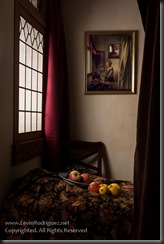
Girl Reading a Letter at an open window


In his book Vermeer’s Hat Professor, Timothy Brooks takes us through the vibrant trade between the new Dutch Republic and the far east, specifically China. He goes through almost every painting identifying objects used by Vermeer and connecting them with the Dutch trade via the first publicly traded company in the world, the Dutch East India Company, Vereenigde Oostindische Blog2014__20120721_Vermeer_GirlClosedWindowAndKeptLetterCompagnie or VOC for short.
Blog2014__20130408_girl-reading-a-letter-by-an-open-window-by-johannes-vermeer Reading the book gave me some ideas about what could possibly doing the “Girl Reading a Letter at an open Window” a.k.a. “The Letter Reader”. Here is my story which is split into two images. Fist the girl in Vermeer’s painting is gone, second a woman is there reading the letter.
First: A girl has read a letter from her lover; a merchant traveling to the Far East on a trading ship. The window is her favourite place to read his letters; the bright light allows her to see all the details of her lover's writings. By now, she carefully folded the letter and tucked in with the all others in a secure drawer in the dresser next room. The Picture in the background reflects the time when she was anxiously reading the letter. 
The self-repeating theme in the frame is an allegory to the many times this scene has occurred in the past but also, to the infinite nature of Vermeer's work.

Second (right): Catharine Bolnes, Vermeer wife has found a letter from an admirer addressed of one of her
older daughters. She must have forgotten to put it away. Catharina is now reading the letter in stupor realizing that her daughter hasn't told her about this pretender. Why hasn't she told her, Is she preparing to elope, like she and Johannes did?

Inspired by Johannes Vermeer -Girl reading a letter at an open window- c. oil on canvas 32 3/4 x 25 3/8 (84 x 65.5 cm) Staaliche Kunstammlungen, Dresden. 
Feel free to connect with me in Facebook or Twitter


Friday, March 28, 2014

Modern photographic renditions of Johannes Vermeer paintings

Very recently I posted one of my “Vermeer” photographs in my Facebook page (Levin Rodriguez Photography). One of my friends searched the “original” and commented about the story behind my version or extension as I call them. I realized that my rendition meant much more to her once she compared it with the actual Vermeer painting. This was a kind of a revelation to me, because I assume that most people know Vermeer’s oeuvre and that they are familiar with his 35 paintings. They are not so many after all.
Therefore I have decided to compile both versions in this post. At left you will have Vermeer’s painting, at right my rendition, you would have to click on it to read the story behind it.  Alternatively, you can come to on June 11-15th to an Exhibition in the McKay Art Centre, Unionville Markham to see them printed on canvas, which in itself enhances the painting effect.  The Exhibition details are here
Blog2014__20130402_GirlInterruptedWrittingALetterNGAW Blog2014__20130210_GirlWrittingALetterSmiling
Blog2014__20130402_WomanHoldingABalanceNGAW Blog2014__20140316_Vermeer_GirlPlayingWithBalance
Blog2014__20121209_Jan_Vermeer_van_Delft_008[1]-2 Blog2014__20121028_vermeer-LittleGirlWithAPearlNecklace
Blog2014__20120625_wtrpitch Blog2014__20121216_Vermeer_GirlOpeningWindow
Blog2014__20130408_girl-reading-a-letter-by-an-open-window-by-johannes-vermeer Blog2014__20130308_Vermeer-TheLetterReader
Blog2014__20130408_2012-06-30 07.37.15 Blog2014__20121026_Milkmaid-FootWarmerFinal
Blog2014__20130408_2012-06-30 07.20.31-2 Blog2014__20121028_vermeer-LittleGirlPlayingViolin
Blog2014__20130408_Jan_Vermeer_-_The_Astronomer Blog2014__20120813_FAA_Vermeer_TheGeographerPhoto
Blog2014__20130424_Girl with an pearl earring Blog2014__20121014_MarianaGirlWithPearlEarringSmiling_ADBE1998-2
Did I mentioned, that you are kindly invited to connect with me via Levin Rodriguez Photography? Just ‘Like” it or ‘Share’ it.

Friday, February 21, 2014

Vanitas, Still Life or Genre?

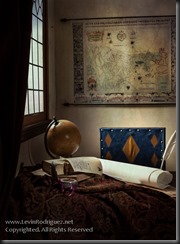
A typical genre painting image of a scribe or calligrapher almost frozen while writing came to me a while ago after I bought calligraphy set. I thought about another “Vermeerish” image, with the light, window, etc. But then, he never gave men leading roles in his paintings, they were all women, even when a man or two were in the picture. Additionally, I had trouble with the monk-look of my protagonist, there were almost nonexistent in Calvinist Netherlands United Provinces. Finally, I decided to include some recognizable Dutch objects like the map in the background and Delft tiles as baseboard. The scribe looks like frozen which is a Vermeerish characteristics, all his models were like that, never moving….almost like still lifes. In a sense, he was a still life painter.

Anyway, I digress, I thought then about incorporating some Vanitas characteristics and that’s why there is a pear on the edge and a candle which symbolizes the transience of life and the temporary nature of our existence. The books are a symbol of education and a way to keep our thoughts for eternity, which is what the character is doing by writing. In this sense, this could be a Vanitas, I leave the judging to you. 

Feel free to connect with me in Facebook or Twitter

Tuesday, October 22, 2013

Why Vermeer?


Whenever I exhibit or present my work, I get asked why I chose Vermeer’s oeuvre for my “photographic paintings”. Was is it just to replicate or copy what the Dutch master painted? 


Well, yes and no. Some of my “Vermeer“ photographs are very similar to the Vermeer painting, but others are completely different, while still being faithful to his lighting style. My intention was to create a composition and a story that could explain the context of a particular Vermeer painting. Sometimes my photograph would explore (fictionally, of course) what happened before, or after the moment represented in Vermeer’s painting. Some other times,, it would be a totally different image that would explore other fictional moments of Vermeer’s life. E.g. A Pronkstilleven from Vermeer to Kalf or Girl painting a dollhouse

In a sense I wanted to replicate his paintings but just as a starting point. In every case, I created my own story to explain what was happening or happened in the moment captured in the image. I profusely used known facts from Vermeer’s life and from Dutch life in XVII Century, including many hand-made artifacts and replicas.

The Story

As I stated in many of my previous posts, I have always been fascinated with classic paintings, not only the technical craftsmanship and skills required were simply exceptional; but they also required a lot of creativity. Just imagine how many different ways you can think of representing a conversation between a soldier and a woman, or how to represent Greek goddesses in the “Judgement of Paris”, or how to represent David before, during or after his battle with Goliath. So, the masters; Bernini, Vermeer, Reubens, Hooch, Michelangelo and others had to go through the same process, they had to think about it, imaging it and then paint it or sculpture it. 


In other, words just technical skill would not have made these pieces the masterpieces there are regarded as today. Their particular selection of a composition, colors and twist in the story made the difference. A good example would be to look at the representation of David by Michelangelo (in the Accademia, Florence), Donnatello in the Bargello, Florence as well and by Bernini (at the Gallery Borghese, Rome). Same character, but what a difference in message. My point is that the artist mind, his/her imagination and its interpretation is as important as the technical skill to paint it. Every piece of art out there looks easy or easier once is done. But coming up with it is what makes some people artists.

Vermeer’s paintings do not represent known stories, he chose to paint about simple moments in the life of middle class and wealthy Dutch people in XVII Century United Provinces. Therefore, for me they represent the starting point in a story, what were they doing? What happened before or after the moment represented in Vermeer’s painting?

The Camera Obscura and the Sketches or the lack of them and

Unlike most painters, Vermeer left no sketches or drawings. Apparently, he just went straight to painting whatever he imagined. One theory revealed by Philip Steadman in his book “Vermeer’s Camera: Uncovering the Truth behind the Masterpieces “is that he used a camera obscura to get the scene proportions, perspective and sizes. Professor Steadman goes into lots of detail about this in his book but also in an interview with “Essential Vermeer”. Click  here if you are interested in reading the interview.

If true, it would make Vermeer a painter who used an optical (the camera obscura was the pre-cursor of the photographic camera) device to capture the scene. Since there was no photographic paper at the time, Vermeer had to capture it “live” on paper, canvas or some sort of surface then, paint over to achieve his masterpieces. It would make him almost a “photographic painter”, I know I am stretching it, but I couldn’t resist.

Connecting the dots

Now you can see where everything starts connecting, I thought about exploring his works in terms of the story and techniques. That is, explore the story of what happened before, after, during or while Vermeer was producing his masterpieces, but also some other aspects of his life. A good example would be his relationship (or lack of it) with other successful painters of his time like Kalf and Rembrandt.


You can see how my photographs are almost like those sketches, which have never been found. In his time, painters would produce many sketches, then they would choose one and paint it. If Vermeer had a camera he would have taken many photos until happy with one (which is what Photographers and some painters do today). Using the camera obscura, would have allowed Vermeer to quickly explore and assess different compositions and discard whatever he did not like without having to draw a sketch. Smart! That would easily explain why he did not produce sketches or drawings (this is part of Professor Steadman’s theory)


I took on myself to create a possible story that explains the image, then create it using a more advanced device than Vermeer, but trying to maintain his style in terms of lighting… which is what photography is all about. (From the Greek photos that means “light” and, graphos that means “drawing”)


Have I succeed?  I leave that to your own judgment.

Feel free to connect with me in Facebook or Twitter

Monday, July 8, 2013

Vermeer and the Virtuous Maid

One of Vermeer's most admired works is the Milkmaid or Kitchen Maid hang at the Rijksmuseum, Amsterdam.

It is a simple composition of a typical house maid in XVII Century Netherlands pouring milk into a bowl. Her face expression conveys absolute and complete absorption in a menial task. This was one of Vermeer earliest works and the only one in such modest room as the kitchen. He quickly moved into fancier, more affluent subjects.

Marjorie E. Wieseman in her book Vermeer's Women attribute the solemnity of the Milkmaid task as a way for Vermeer to attribute virtue to maids, who were generally viewed with suspicion at the time. Maids were normally pictured with her mistresses or sleeping on a table, or listening to a conversation in other words either as secondary subjects or suspicious main ones. In a stark contrast, Vermeer shows us a painting where the maid is the main subject AND she is putting all her attention into her job, no matter how menial it may seem. It is this, the fact that she takes so seriously such a simple job what makes the maid virtuous.

I loved the idea of conveying virtue by picturing solemnity in a menial task, but I chose a different subject, one that allows me to blend a Vermeer subject with a Bosschaert (Ambrosious Bosschaert the Elder) subject which is another favourite of mine; flower bouquet paintings. 

Here is my image and my story that goas as:
A girl is graciously arranging a flower bouquet to honour important evening visitors, Pieter Claesz Van Ruijn and his wife Maria de Knuijt. They are Jan Vermeer's most important patrons and are coming today to look at his newest painting of a girl wearing a pearl earring. Money is tight; hence, the Vermeers are hoping that Van Ruijn will like the new masterpiece and purchase it.

They are trying to embellish the house with their best pieces for the event. They wanted to impress Van Ruijn and his wife, therefore they invested a small fortune in a flower bouquet, that include the latest arrival of exotic flowers from Turkey; tulips and an Iris which symbolizes the trinity. They also hung a still life painting from Pieter Claesz, the famous Harleem painter. They thought that since he has the same name as Van Ruijn it would make for a good conversation.

The little girl is completely absorbed in her task, totally unaware of the tension around the patrons visit and the implications of the results. She innocently and happily arranges the flowers, completely unaware of what worries the adults. She is humming her favourite song while her innocent mind is solely occupied by her admiration of nature's power to produce these wonderful colourful creations called flowers.

Follow me in Facebook